

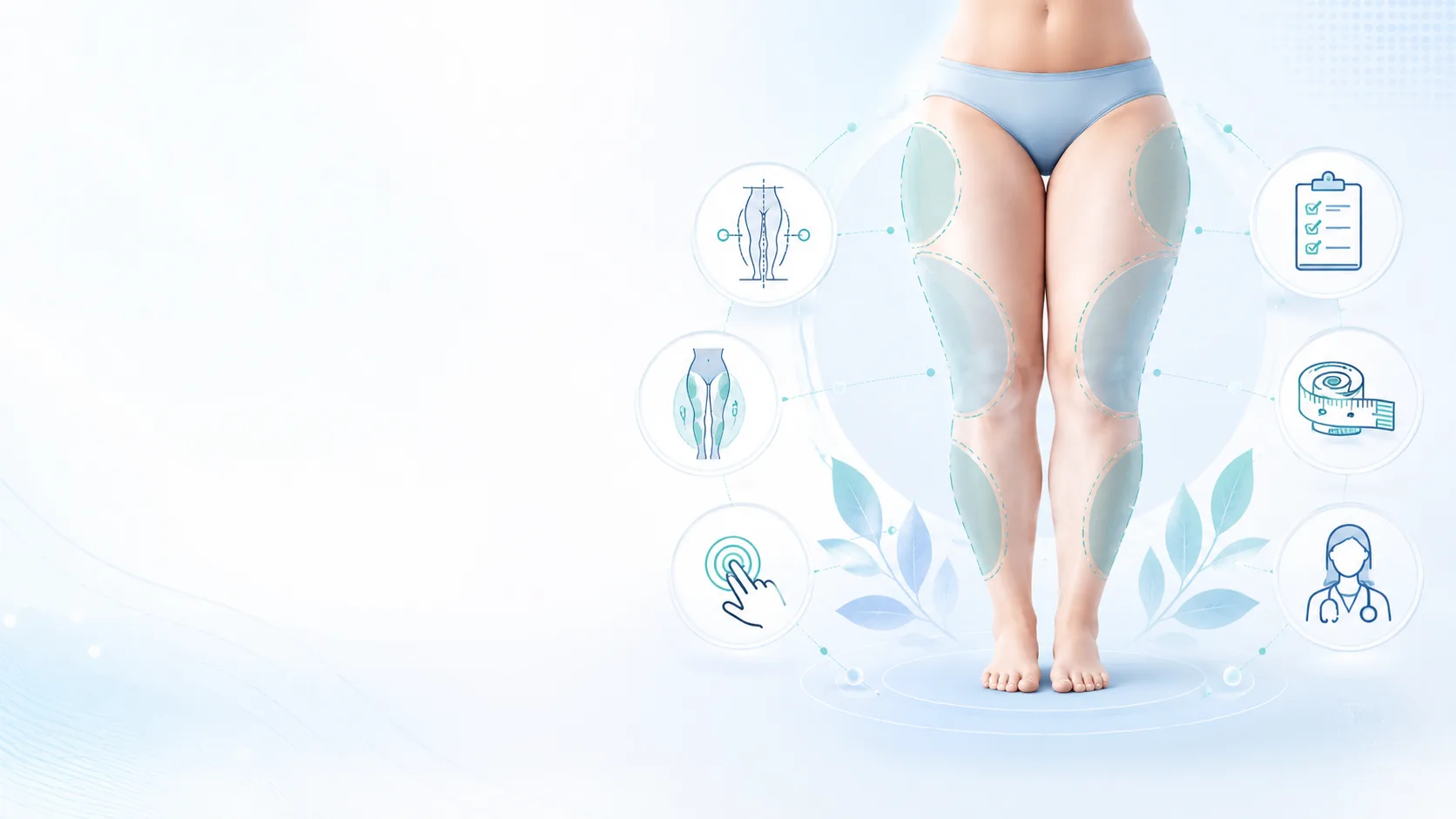
Legs do not get thicker for one reason only. General fat gain, muscle development, edema, venous insufficiency, lymphedema, thyroid disease, insulin resistance or a lipedema-type fat distribution can all change leg size. The useful questions are: is it symmetrical, are the feet spared, does the tissue hurt when touched, does swelling increase by evening, and is the lower body clearly disproportionate to the upper body?
Lipedema is a chronic adipose tissue disorder, seen mainly in women, that can cause symmetrical and disproportionate enlargement of the legs, hips and sometimes arms, often with pain, tenderness and easy bruising. Current guidelines emphasize that lipedema should not be diagnosed by appearance alone; pain, tissue sensitivity, distribution pattern and differential diagnosis must be read together (Faerber et al., 2024; Mortada et al., 2025).
Is leg enlargement fat, fluid or muscle?

Fat gain usually progresses slowly; edema can fluctuate during the day; muscle development fits an exercise history; venous or lymphatic problems often bring heaviness, fullness, sock marks or ankle swelling.
If the feet remain relatively slim, a cuff-like ankle border appears, touch hurts and the lower body resists dieting, what is the lipedema becomes a clinically meaningful clue rather than a cosmetic detail.
How lipedema makes legs look thicker
Lipedema usually affects both legs fairly symmetrically. Patients may say, “my upper and lower body do not match,” or “my face gets thinner when I lose weight, but my legs stay the same.” This wording captures disproportion, but it does not diagnose lipedema by itself.
In lipedema, thickness is rarely only aesthetic. Pain, pressure sensitivity, end-of-day heaviness and easy bruising may accompany it; what are the symptoms describes this broader symptom pattern.
Obesity-related leg enlargement
In obesity, fat gain is usually more generalized, involving the abdomen, waist, trunk, arms and legs. In lipedema, the lower body may stay disproportionately larger. The two conditions can coexist and one can hide the other (Bindlish et al., 2023).
When waist gain, insulin resistance, sleep apnea or metabolic risk is present, lipedema vs obesity how helps read leg enlargement beyond appearance alone.
When edema makes legs thicker
Edema means fluid accumulation in tissues. Leg size may change during the day, sock marks may appear and pressing a finger may leave a temporary pit. Lower limb edema can have venous, lymphatic, cardiac, renal, medication-related and systemic causes that overlap (Gasparis et al., 2020).
People with lipedema may feel heaviness “as if there is edema,” but lipedema is not simply fluid retention. When the foot is involved, one leg is much larger or true swelling is present, is leg swelling lipoedema gives a safer frame for separating fat tissue, fluid, veins and lymphatic load.
Lymphedema and venous insufficiency
Lymphedema develops when the lymphatic system cannot drain tissue fluid adequately. Compared with lipedema, it more often involves the top of the foot and toes, may be asymmetric and can lead to skin thickening over time. The International Society of Lymphology recommends combining history, examination, staging and imaging when needed (International Society of Lymphology, 2020).
Venous insufficiency means that leg veins do not return blood efficiently toward the heart. Heaviness after standing, varicose veins, ankle swelling and skin discoloration may point toward venous load. how to distinguish lipedema and can lipoedema and venous help turn this overlap into a practical clinical distinction.
Thyroid disease, insulin resistance and hormones
Hypothyroidism can bring fatigue, weight gain tendency, constipation, cold intolerance and a feeling of swelling. It does not directly cause lipedema, but it can add to weight change and edema perception in the same patient (Chaker et al., 2017). lipedema and thyroid problems is relevant when leg enlargement comes with fatigue or generalized puffiness.
Insulin resistance is not the single cause of thick legs either, but waist gain, cravings and difficulty managing weight change the metabolic context. lipedema and insulin resistance helps separate lipedema tissue resistance from general metabolic weight gain.
Muscle, body type and urgent signs
Not every strong or thick leg is a disease. Strength training, cycling, running, dance, genetics and body type can make thighs and calves more prominent. Muscle is not usually tender like painful fat tissue and should not come with easy bruising or daily swelling swings.
Lipedema is usually symmetrical. Sudden one-sided swelling, new severe calf pain, warmth, redness, shortness of breath, chest pain or fainting should not be watched as lipedema; clot, infection, trauma or other urgent causes must be excluded.
Six questions that organize the story
- Is it symmetrical?
- Are the feet spared?
- Does touch hurt?
- Does it change during the day?
- Where do you lose weight first?
- Are there sock marks, varicose veins or skin color changes?
These questions do not diagnose. They help prepare for an appointment. When symptoms are confusing, lipedema self-test should be used as an awareness tool, not as a diagnostic promise.
How the cause is assessed
Assessment starts with history and physical examination: distribution, tenderness, bruising, foot involvement, skin changes, varicose veins, sock marks, weight history, medications and comorbidities. Venous Doppler ultrasound, blood tests, lymphatic assessment or imaging may be added when indicated.
The S2k guideline notes that laboratory and instrument-based tests cannot prove lipedema by themselves; they mainly support differential diagnosis and the evaluation of associated problems (Faerber et al., 2024). diagnostic methods used in therefore strengthens the idea of reading the clinical picture as a whole.
In practical terms
Thicker legs should not be reduced to one explanation. Lipedema, obesity, lymphedema, venous insufficiency, thyroid problems, insulin resistance, muscle development, medications and systemic edema all leave different clues. The safest approach is to interpret leg size together with pain, symmetry, foot involvement, daily change, bruising, vascular signs and overall health.
