

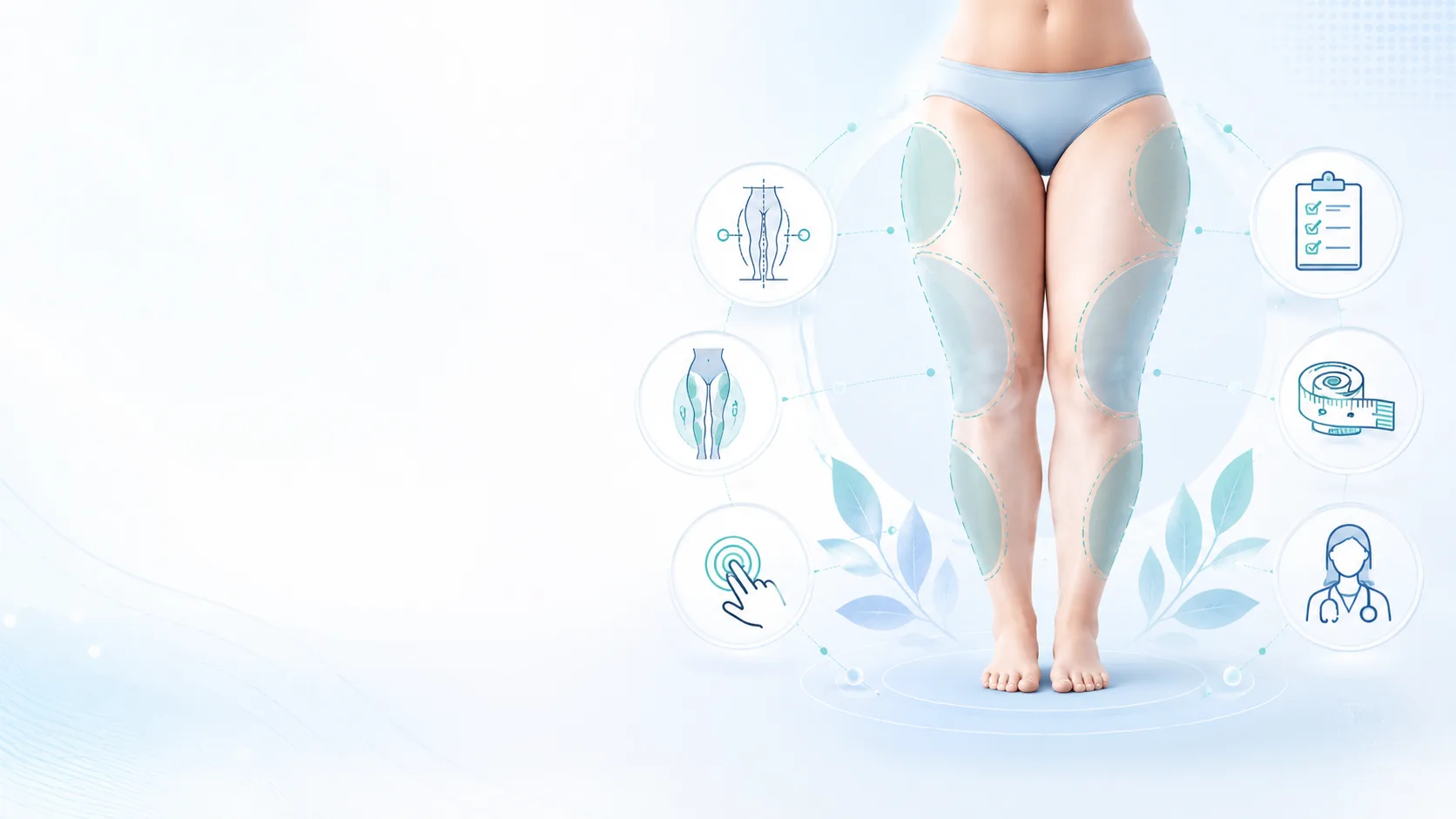
Lipedema symptoms are often not limited to just "thickness of the legs." In a typical picture, there is a bilateral, symmetric increase in fatty tissue in the legs and sometimes in the arms; sensitivity to touch, pain, easy bruising, a feeling of heaviness by the end of the day, and relative preservation of the feet are observed together. Weight loss may reduce overall body measurements; however, the lipedematous areas do not usually shrink as expected in most patients. Therefore, lipedema should not be considered merely as an aesthetic issue or classic weight gain. If you are reading this for the first time, understanding what lipedema is will make the symptoms in this article more meaningful.
What are the most common symptoms of lipedema?

The symptoms of lipedema are not limited to appearance; pain, sensitivity, easy bruising, and distribution characteristics are evaluated together.
Patients often describe their experience as "my legs are always thick," "it hurts to touch," "I bruise easily," or "my upper body is getting thinner, but my legs stay the same." The most important clues for the diagnosis of lipedema in current guidelines are the disproportionate increase in fatty tissue in the extremities compared to the torso, pain or sensitivity, bilateral symmetric distribution, and differentiation from similar conditions (Faerber et al., 2024; Kruppa et al., 2020).
Symmetric thickening in the legs, hips, and sometimes in the arms
Pain and sensitivity that increase with touch, pressure, or by the end of the day
Tendency to bruise easily
Relative preservation of feet and hands in most patients
Less reduction in the lower body than expected despite diet and exercise
Feeling of heaviness after prolonged standing, hot weather, or busy days
Impaired movement in advanced stages, increased mechanical load around the knees and hips
Is leg thickness a symptom of lipedema on its own?
No. Leg thickness alone does not diagnose lipedema. Obesity, muscle structure, venous insufficiency, lymphedema, thyroid issues, medication-related edema, and immobility can also change the appearance of the legs. The distinguishing point in lipedema is that the increase in volume is accompanied by pain, sensitivity, easy bruising, and significant disproportion. It is also incorrect to interpret every leg thickness solely as weight; the difference between lipedema and obesity clarifies this distinction with the patient’s daily observations.

In lipedema, pain and sensitivity cannot be explained by a single mechanism; tissue, vascular, neural sensitivity, and circulatory load are considered together.
How is lipedema pain felt?
Lipedema pain is not the same in every patient. Some patients describe sensitivity to touch, while others report feelings of deep pressure, burning, throbbing, heaviness, or fatigue. The pain may increase throughout the day, become more evident with prolonged standing, or fluctuate with menstruation, hot weather, and physically demanding days. In prospective clinical data, pain, bruising, symmetric involvement, and preservation of the feet are frequently reported findings (Forner-Cordero et al., 2021). Since the nature of the pain changes the treatment plan, lipedema pain should be evaluated as a separate topic.
Why is easy bruising important in lipedema?
Lipedema patients often report bruising even from minor bumps. This finding alone does not diagnose lipedema; however, when accompanied by pain, sensitivity, and symmetric fatty tissue increase, it can support the picture. Nonetheless, widespread bruising, nose-gum bleeding, the use of blood-thinning medications, or newly emerging unexpected bruises require separate evaluation in terms of the bleeding-coagulation system. Therefore, bruising in lipedema explains not only the lipedema symptom but also when other causes should be investigated.
What does preservation of the feet and cuff sign mean?
In lipedema, the increase in fatty tissue often creates a noticeable boundary at the level of the ankle; the top of the foot is generally preserved. This appearance is commonly described as "cutting at the ankle" among the public. In the medical field, this can be referred to as the cuff sign. This finding provides a clue in favor of lipedema, but it is not a diagnosis on its own. If there is significant swelling on the top of the foot, thickening of the toes, or unilateral progressive edema, lymphedema and vascular diseases should also be considered. the cuff sign in lipedema differentiates the importance of this appearance in layman's terms.
Can symptoms occur in the arms as well as the legs?
Lipedema is most noticeable in the hips, thighs, and legs. In some patients, the upper arm area may also be affected. The preservation of the back of the hand in most patients provides a clue similar to the preservation of the feet in the legs. If arm involvement is present, it should also be evaluated whether it confuses with weight gain, lymphedema, past surgeries, radiotherapy, or vascular problems. lipedema types provides a more organized classification of the affected areas.
Does the feeling of edema always indicate real fluid retention?
When a patient says "I am swollen," it does not always mean measurable fluid edema. In lipedema, tissue tension, pain, sensitivity, and the feeling of heaviness by the end of the day can make the patient feel like they have edema. Additionally, venous insufficiency, prolonged standing, hot weather, salt intake, hormonal periods, or lymphatic load can also contribute to actual fluid increase. If there is increased heaviness by the end of the day, varicose veins, swelling that leaves marks around the ankles, and color changes, lipedema and venous insufficiency correctly situates this confusion.
Are lipedema symptoms the same thing as stages?
Symptoms and stages are not the same thing. Symptoms are the pain, sensitivity, bruising, heaviness, and movement restrictions experienced by the patient. The stage is a clinical classification based on the appearance of the skin surface and fatty tissue. In the early stage, pain can be very pronounced; in the advanced stage, however, not every patient's pain may be of the same intensity. Therefore, it is not possible to understand the patient's complaint level by just looking at the photo or skin appearance. lipedema stages particularly fulfills this distinction regarding treatment expectations.
Which symptoms suggest another condition instead of lipedema?
Some findings suggest diseases other than lipedema. Sudden unilateral leg swelling, new severe pain in the calf, warmth-redness in the leg, shortness of breath, chest pain, or feeling faint should not be delayed in being explained as lipedema. These may be related to vascular obstruction, infection, or other conditions requiring urgent evaluation. Gradually developing but pronounced swelling of the top of the foot, thickening of the toes, and edema that leaves marks should be investigated in terms of lymphedema or venous disease. the difference between lipedema and lymphedema is therefore a safe checkpoint before diagnosis.

Pain, swelling, or leg thickness does not always originate from the same cause; differential diagnosis is therefore important.
What should the patient review about themselves?
Observations made at home do not diagnose; however, they make the doctor visit more efficient. It is helpful for the patient to note the location of the pain, frequency of bruising, whether the feet are preserved, feeling of heaviness by the end of the day, similar body structure in the family, response of legs to weight change, and the relationship of complaints with periods such as menstruation/pregnancy/menopause. When findings appear disconnected, the patient may be misled for years with different explanations. lipedema self-test is not a tool for diagnosis, but a preparatory area that can be used to review these findings regularly.

Regularly noting symptoms does not diagnose; however, it helps to explain the properties of pain, sensitivity, and distribution more clearly during the doctor visit.
What should be the first step if there are symptoms of lipedema?
If you suspect lipedema, the primary goal is not to diagnose yourself, but to prepare for an accurate evaluation. Clinical examination, history, body distribution, inquiry of pain-sensitivity, and differential diagnosis should be considered together. If necessary, venous Doppler ultrasound, metabolic evaluation, or consultations from different specialties can be planned. Knowing how the diagnostic process progresses reduces unnecessary fear for the patient; how is the diagnosis of lipedema made explains the transition from symptoms to diagnosis at this stage more clearly.
Is it possible to reduce the symptoms?
The promise to completely eliminate lipedema fatty tissue with a single method is incorrect. Nevertheless, pain, heaviness, tissue tension, movement capacity, and quality of daily life may become more manageable for many patients with planned follow-up. Nutrition, low-impact exercise, manual lymph drainage, compression, sleep, and regulation of metabolic issues are all parts of the same plan. If tissue tension and end-of-day fullness are prominent, manual lymph drainage and compression should be viewed as a supportive step in managing complaints, not as treatments.