

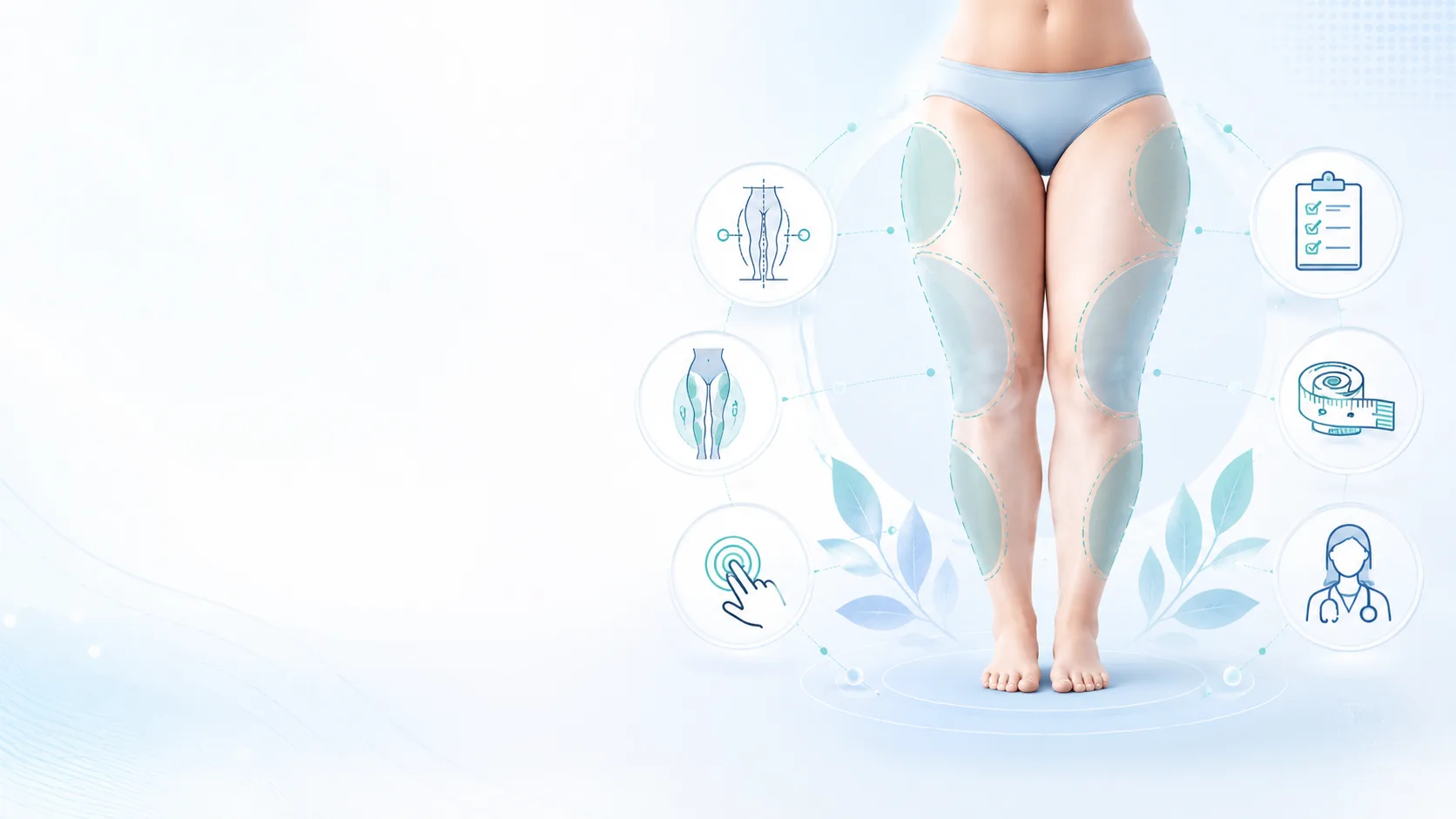
The most honest answer to “what causes lipedema?” is that there is no single proven cause. Lipedema appears to develop through an interaction between inherited susceptibility, female hormonal transitions, connective tissue behavior, microvascular permeability, interstitial fluid, lymphatic load and the biology of subcutaneous adipose tissue. Reducing it to “weight gain” is inaccurate; calling it purely genetic and unchangeable is also incomplete.
Current guidance describes lipedema as a chronic disorder with symmetrical disproportionate subcutaneous fat accumulation, pain, tenderness, easy bruising and often relative sparing of the feet (Faerber et al., 2024; Herbst et al., 2021). The key issue is not only fat quantity, but how that tissue behaves: painful, pressure-sensitive, fluid-prone and often resistant to ordinary weight-loss patterns. what lipedema is gives this broader diagnostic frame.
Why one cause is not enough
Many patients remember a timing: puberty, pregnancy, menopause, hormonal treatment or a family pattern. These observations matter, but lipedema cannot yet be explained by one hormone or one gene. Rabiee (2025) describes lipedema adipose tissue as a complex microenvironment involving adipocytes, fibrosis, inflammation, immune cells and connective tissue changes.
In practice, fat cells are not alone. They sit among tiny blood vessels, lymphatic channels, nerve endings and connective tissue fibers. If microvascular leakage increases, interstitial fluid may rise; if tissue pressure increases, pain and heaviness may worsen; if pain reduces movement, the muscle pump weakens. This is why the disease often feels like a loop rather than a single event.
Genetic predisposition
Family history is common in lipedema. Genetic predisposition does not mean every daughter will have the same disease pattern. It means some people may inherit a tissue and fat-distribution background that is more vulnerable. Morgan et al. (2024) reported findings supporting inherited risk in family-based sequencing, but there is no routine single genetic test that diagnoses lipedema.
Family patterns can also hide the disease because patients are told that their body shape is simply “how the family is.” When pain, easy bruising, symmetrical enlargement, spared feet and diet resistance cluster together, lipedema symptoms becomes more than a checklist; it helps organize the clinical story.
Hormones and timing
Lipedema predominantly affects women and often appears or worsens around puberty, pregnancy, postpartum changes or menopause. Estrogen is therefore an important research focus. Katzer et al. (2021) reviewed how estrogen signaling may influence fat storage, glucose handling, lipolysis and vascular growth in adipose tissue.
This should not be simplified to “estrogen causes lipedema.” A better interpretation is that hormonal transitions may reveal or amplify a susceptible lower-body subcutaneous fat depot. Stage and tissue response then differ from patient to patient; lipedema stages helps connect appearance with pain, fibrosis, fluid load and function.
Connective tissue, fluid and heaviness
Connective tissue is the support network around cells, vessels and nerves. If this network becomes more compliant and fluid accumulates between tissue fibers, legs may feel heavy, full and tender. Allen et al. (2020) found increased interstitial fluid findings in lipedema skin, while Crescenzi et al. (2023) used noninvasive 3T MR lymphangiography to show subcutaneous adipose tissue edema in lipedema.
This helps patients understand that “fat legs” is an oversimplification. Fluid pressure, vessel permeability and lymphatic capacity are part of the story. The overlap with lymphedema and venous disease is why lipedema and lymphedema differences directly changes treatment planning.
Microvessels, bruising and inflammation
Easy bruising may reflect small-vessel fragility, connective tissue support, tissue pressure and inflammatory signaling. Inflammation here does not mean infection; it means a long-lasting low-grade tissue signal involving immune cells. Grewal et al. (2025) discussed a possible role for macrophages and M2 polarization in lipedema, strengthening the idea that lipedema is not passive fat storage.
Why lipedema is confused with obesity
A patient may have both lipedema and obesity, but they are not the same condition. Obesity often involves more generalized fat distribution and may be more closely linked to visceral fat and metabolic disease. Lipedema is more regional, painful, tender and often resistant in the legs. lipedema vs obesity is clinically important because blaming every enlarged leg on weight delays diagnosis.
Are diet and inactivity causes?
Poor diet and inactivity do not fully cause lipedema. A physically active or normal-weight person can still have it. Yet nutrition and movement still matter because blood sugar swings, low protein intake, constipation, fluid imbalance and weak muscle pump can worsen symptoms. lipedema nutrition and lipedema exercises are therefore part of symptom management, not proof that the patient caused the disease.
The lymphatic system
The lymphatic system drains excess fluid and proteins from tissues. Early lipedema is not identical to classic lymphedema, but increasing tissue size, fluid load and reduced movement may strain lymphatic transport over time. This is the logic behind compression and lymphatic care. manual lymph drainage and compression should be understood as support for tissue load and comfort, not as a fat-burning method.
When should a patient suspect lipedema?
Symmetrical leg enlargement, relative foot sparing, touch pain, easy bruising, poor response of the lower body to diet or exercise, family history and hormonal onset form a meaningful pattern. When these features are present, lipedema self-test can help patients review their symptoms in an organized way; it does not diagnose the disease, but it can prepare the patient for medical evaluation.
Conclusion
Lipedema does not fit into one sentence. It is shaped by genes, hormones, connective tissue, microvessels, fluid, lymphatic load, immune signaling and adipose tissue biology. Understanding these mechanisms protects the patient from blame and helps the clinician choose a more precise starting point for care.