

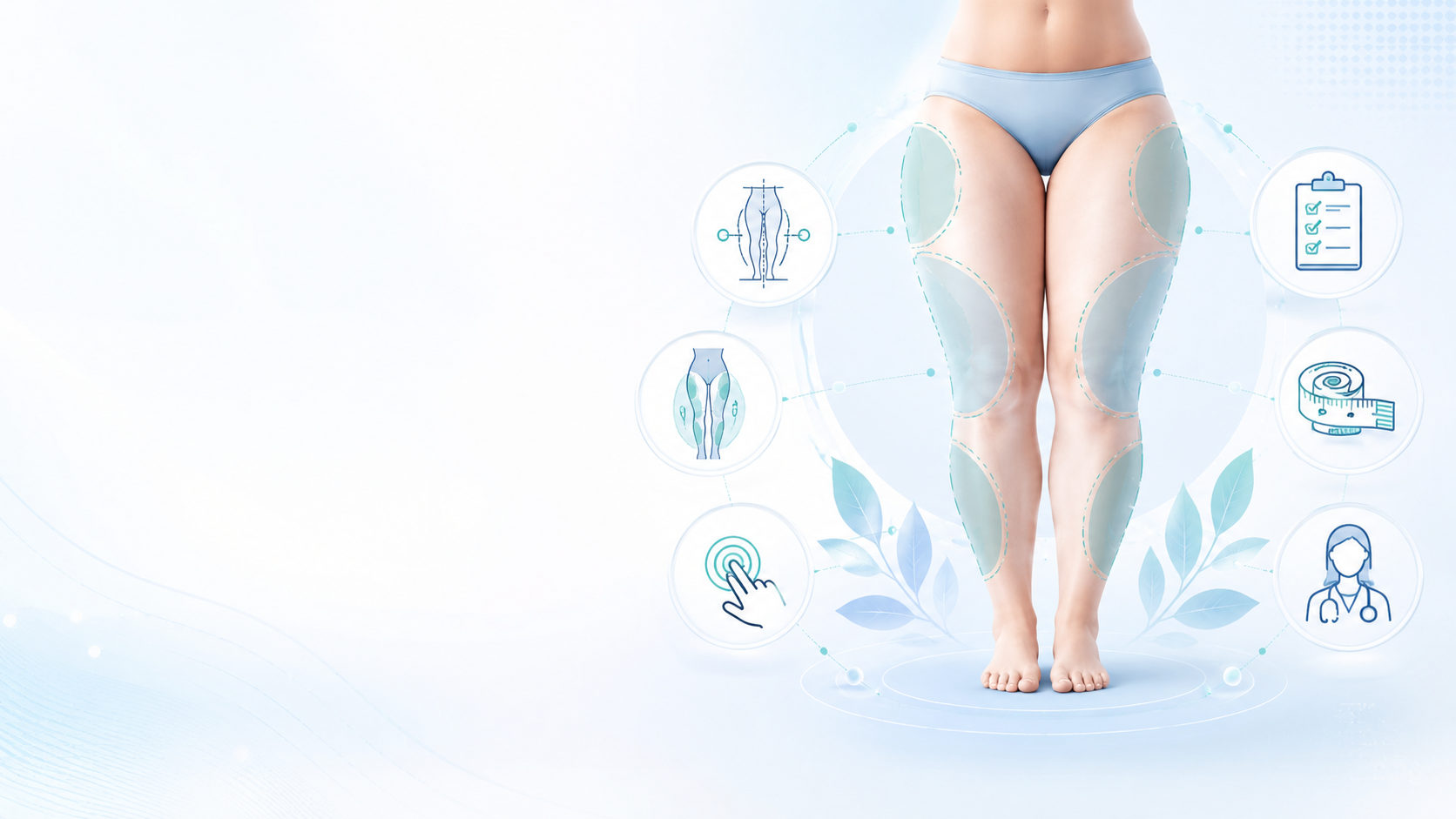
The genetic predisposition in lipedema is a strong possibility; however, there is no "lipedema gene" that can solely explain lipedema and is evaluated and diagnosed in everyone today. If there is a similar leg-arm structure, pain, easy bruising, and the lower body does not slim down despite diet in family members such as mother, sister, aunt, or grandmother, this information is valuable in the diagnostic interview. Still, having a family history is not fate; the absence of a family history does not exclude lipedema either. The most accurate approach is to consider genetic predisposition together with hormones, connective tissue, vascular-lymphatic structure, inflammation, and lifestyle.
Is lipedema genetic or does it develop later?
Patients often ask this question with concerns like, “My mother had it, and it started with me; will my daughter also have it?” The answer is not simple enough to be given in a single word. Family clustering in lipedema has attracted attention for a long time. undefined discussed that lipedema might have a hereditary aspect by evaluating family trees, especially considering the possibilities of autosomal dominant or X-linked inheritance that become evident in women. Autosomal dominant inheritance means that the genetic effect that creates susceptibility to the disease can come from just one parent; however, this model does not explain every family in lipedema.
Recent studies have clarified the picture a bit more: lipedema is probably not a single-gene disease that operates the same way in every patient; it is a complex condition that arises more from a combination of genetic predisposition, hormonal periods, connective tissue characteristics, and tissue-level vascular-lymphatic responses. Therefore, addressing why lipedema occurs should be approached as a picture representing the intersection of several biological lines rather than seeking “one cause.”
What does it mean to have lipedema in the family?
Family history is one of the most valuable pieces of information provided by the patient during the diagnostic interview. Sentences like “My mother’s legs resembled mine,” “My aunt always complained about bruising,” “My sister loses weight but struggles with her legs while her upper body slims down” are important. These sentences do not alone lead to a diagnosis, but they guide the physician to look more carefully at lipedema.
It is not enough to only ask about family members who have received a diagnosis. In older generations, lipedema may often have been described as “structural legs,” “cellulite,” “varicose veins,” “weight problem,” or “body type inherited from the mother.” Therefore, even if the diagnosis name is unknown in the family, details such as disproportion in the lower body, pain, easy bruising, tenderness upon touching the legs, and relative protection of the feet should be questioned together.
If there is no family history, can there be no lipedema?
No. The absence of family history does not exclude lipedema. There are several reasons for this. First, individuals in the family may never have received a diagnosis. Second, symptoms may have remained very mild in some family members. Third, genetic predisposition might not appear with the same age, in the same region, or with the same severity in everyone in the same family. This situation is referred to as variable expressivity in medicine; in other words, the same predisposition may manifest differently in different individuals.
Another term is penetrance. Penetrance describes the probability that a genetic predisposition actually manifests as symptoms. To put it in the patient’s everyday language: there may be a predisposition in the family, but everyone might not experience the same condition. For this reason, family history is an important clue; however, it is not a standalone diagnosis or exclusion criterion. The real framework is formed by lipedema symptoms such as pain, symmetry, disproportion, easy bruising, preservation of hands and feet, and response to weight loss.
What do current genetic studies say?

The most important point in lipedema genetics is this: studies support familial predisposition, but they have not yet produced a simple genetic test that can be applied to everyone in clinical practice. undefined examined a well-defined UK lipedema cohort of 200 individuals and conducted a genome-wide association analysis on 130 of them. In the study, some genetic regions near LHFPL6 caught attention; however, the authors emphasized that these findings need to be replicated in different populations.
undefined published a large family-based study examining DNA samples from 31 people from nine lipedema families. In this study, no single common disease gene explaining all families was found; instead, different candidate variants in different families came to the forefront along with biological pathways like microfibril binding, vasopressin receptor activity, and patched binding. This result tells the patient: the genetic effect in lipedema could be real, but this effect is likely too complex to be explained by a single switch.
Why is the AKR1C1 gene so frequently mentioned?
AKR1C1 refers to a gene involved in steroid hormone metabolism. Important hormones such as estrogen and progesterone play critical roles in women’s life cycles among steroid hormones. undefined identified a notable variant in the AKR1C1 gene in a family with non-syndromic primary lipedema. This study has opened a valuable door, as it suggests that a biological link could be established between lipedema, hormone metabolism, and adipose tissue behavior.
However, expectations need to be set correctly here. The presence of AKR1C1 does not mean that the same genetic disorder exists in every lipedema patient. This gene is not used as a routine diagnostic test today. A more accurate expression is this: AKR1C1 is one of the significant candidates that highlights why hormone metabolism and the biology of adipose tissue should be studied in lipedema. Therefore, understanding lipedema and hormones is part of the same line of inquiry into why lipedema can become more apparent during periods like puberty, pregnancy, and menopause.
Why is it especially seen in women?
The prominence of lipedema in women suggests that genetic predisposition does not work independently of hormones. The disease is often noticeable around puberty, pregnancy, the postpartum period, or menopause. During these periods, adipose tissue, vascular permeability, connective tissue, fluid balance, and energy metabolism change simultaneously. For a person with genetic predisposition, these changes may make lipedema symptoms more evident.
This does not mean that “hormones alone cause lipedema.” It could be more accurately thought of as the existing predisposition coming to the forefront at specific times. The situation is even more sensitive during pregnancy; because the mother’s vascular-fluid balance, weight changes, and pain management must be considered alongside the baby's physiology. Therefore, in the lipedema and pregnancy section, the importance of obstetrician insight being at the center of the process is emphasized.
Does nutrition and exercise help when there is a genetic predisposition?
Yes, but it is important to set expectations correctly here. Nutrition, exercise, compression, or manual lymph drainage does not change genes. Nevertheless, it can positively influence pain, feelings of heaviness, blood sugar fluctuations, bowel regulation, sleep, muscle strength, and quality of life. The genetic predisposition should not send a message to the patient that “I can’t do anything.” On the contrary, early awareness provides an advantage for a good follow-up plan.
A lipedema patient's response to weight loss may differ from that of classical obesity. Just because the upper body is slimming while the legs remain more resistant does not imply the patient lacks willpower. If this distinction is not understood, the patient may blame themselves for years. The difference between lipedema and obesity is crucial to reducing this false sense of guilt; since the mechanism of adipose tissue with genetic predisposition is not the same as general weight gain.
How are connective tissue, hypermobility, and family structure related?
The prominence of biological categories suggesting connective tissue, such as microfibril binding, in the study by undefined is noteworthy. Microfibrils are small but significant parts of the elastic and supportive structures of connective tissue. Some patients with lipedema may experience joint laxity, easy sprains, tissue tenderness, a feeling of skin elasticity, or widespread pain similar to fibromyalgia. These findings do not occur in every patient; however, if there are “flexible joints,” frequent sprains, or connective tissue problems in the family, it is beneficial to note this.
This relationship has not yet established a definitive cause-and-effect line. However, viewing lipedema solely as fat storage is insufficient. Adipose tissue, the environment around blood vessels, connective tissue, nerve endings, and inflammatory signals work together. undefined also emphasizes that lipedema should be studied as a multifactorial disease where genetic predisposition, hormonal influences, vascular changes, and adipose tissue biology intersect.
What should be considered for daughters in families with lipedema?
If there is lipedema in the family, careful monitoring of body changes in adolescent daughters is crucial. The aim here is not to worry the child about weight, leg appearance, or body measurements. On the contrary, it is to calmly observe signs such as pain, easy bruising, tenderness in the legs upon touch, disproportionate pain after exercise, protection of the feet, and increasingly obvious differentiation of the lower body.
Not every body change during adolescence is lipedema. During this period, growth, hormones, muscle development, fat distribution, and psychological sensitivity are intertwined. If there is a family history, discussing with a physician early on allows the child to grow up with correct information without blaming themselves. The lipedema self-test should be considered not as a diagnostic tool, but as a step towards awareness that helps regularly review symptoms and be more prepared for the physician's assessment.
Is it necessary to undergo genetic testing?
Currently, there is no routine genetic test recommended for patients suspected of having lipedema that leads to diagnosis and directly influences treatment. Genetic research is very valuable; however, in clinical practice, the diagnosis of lipedema is still made through history, physical examination, symptom patterns, and differential diagnosis. When necessary, venous assessment, lymphatic assessment, metabolic testing, or screening for accompanying diseases is performed.
Genetic testing may only come to the forefront in situations such as research protocols, suspicion of rare syndromes, very specific family histories, or conditions deemed appropriate by a genetic specialist. What patients need to primarily do in practice is to be able to regularly recount their family history: who had a similar leg structure, was there pain, did bruising occur, did it become evident after pregnancy or menopause, was it confused with varicose veins-lymphoedema-obesity diagnoses?
Can menopause and family history together change the picture?
Yes, in some patients, the menopausal period can be a time when family predisposition is felt more distinctly. Changes in estrogen levels, sleep disturbances, hot flashes, reduction in muscle mass, increase in waist circumference, and changes in insulin sensitivity can make lipedema complaints more complex. If there is a similar story in the family such as “my legs became heavier after menopause,” this information is also valuable.
However, this should not be read as “menopause causes lipedema.” Menopause may be a time when existing predisposition and tissue sensitivity become more evident. The lipedema and menopause section addresses hormone changes, pain, feelings of edema, weight management, and sleep patterns within the same plan.
How should you take family history notes in practice?

Preparing a brief family note before visiting a doctor often proves very useful. You can write if there are similar body shapes, pain, easy bruising, diagnoses of varicose veins, diagnoses of lymphoedema, tenderness in the legs upon touch, noticeable changes after pregnancy, or increases after menopause among female relatives such as mother, sister, aunt, grandmother, and, if possible, female relatives on the father's side. If male relatives have unusual lower body fat, hormone treatment, liver disease, or significant hormonal issues, this information can also be noted.
This note is not for diagnosis but to help the physician better understand the case. A single-sentence answer to the patient's question, “Why did this happen to me?” is often insufficient. Genetic predisposition is information that does not blame the individual but makes the process easier to understand.
In summary, how should we think?
In lipedema, genetic predisposition is a strong possibility; however, it is not accurate to describe it as a single gene, single test, or single cause today. If there is a family history, this information should be taken seriously; otherwise, the possibility of lipedema should not be automatically excluded. Genetic structure works together with hormonal periods, connective tissue, vascular-lymphatic systems, inflammation, metabolic status, and lifestyle. The practical conclusion for the patient is this: don’t hide your family story, regularly track your symptoms, don’t blame yourself, and ask for a holistic evaluation with a physician who understands lipedema during the diagnostic process.
