

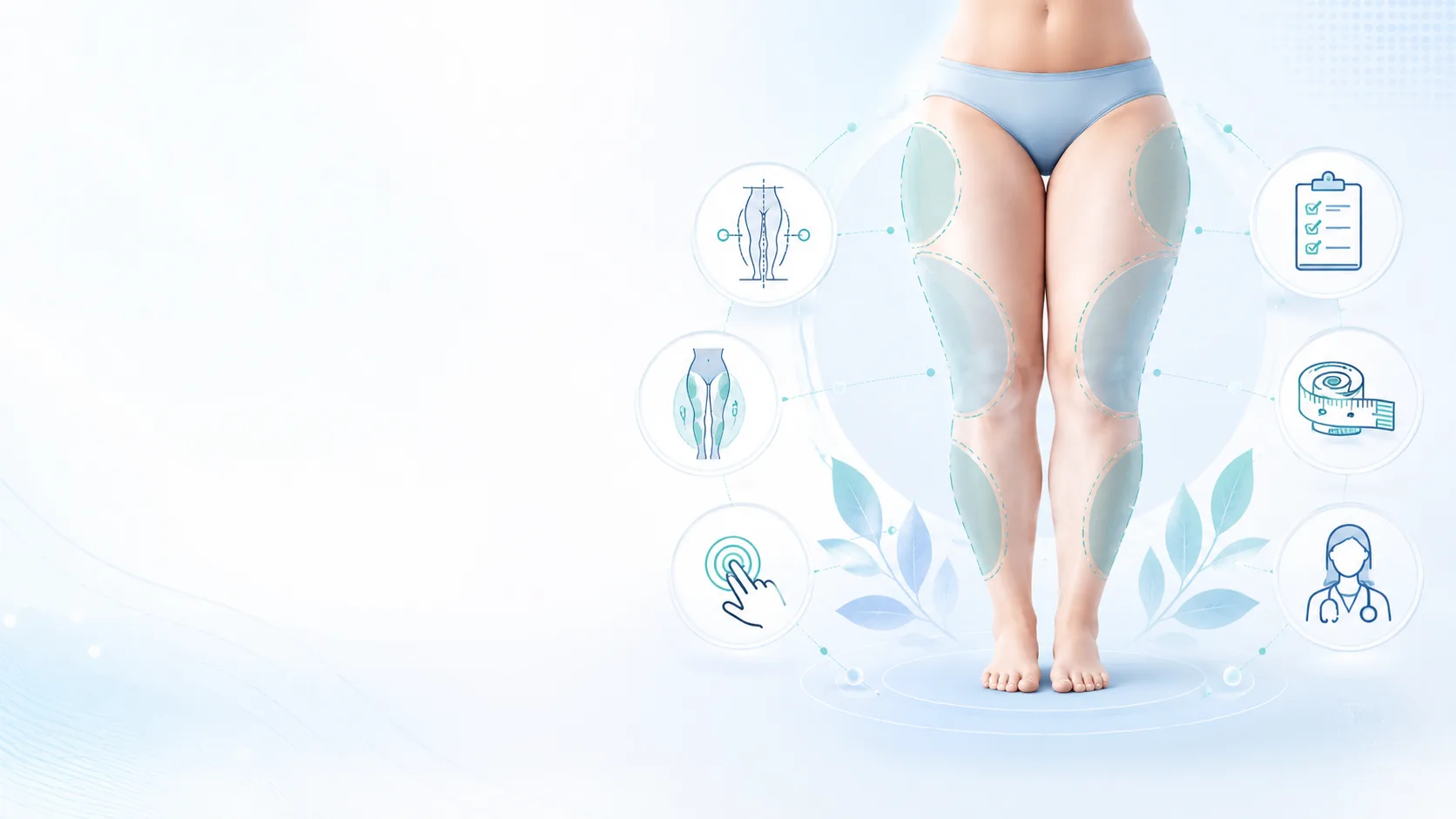
Genetic predisposition to lipoedema is a strong possibility; however, as of today, there is no single "lipoedema gene" that explains lipoedema alone, observed in everyone and used for diagnosis. If similar leg-arm structures, pain, easy bruising, and despite diet, lack of thinning in the lower body is present in family members such as mother, sister, aunt, or grandmother, this information is valuable in the diagnostic consultation. Nevertheless, having a family history is not fate; the absence of a family history does not exclude lipoedema either. The most accurate approach is to consider genetic predisposition in conjunction with hormones, connective tissue, vascular-lymphatic structure, inflammation, and lifestyle.
Is lipoedema genetic or acquired later?
Patients often ask this question with the worry, “My mother also had it, and it started with me; will my daughter get it too?” The answer is not simple enough to be given in a single word. Family clustering in lipoedema has drawn attention for a long time. Child et al. (2010) discussed the possibility that lipoedema may have a hereditary aspect, particularly in regard to autosomal dominant or X-linked inheritance patterns that become evident in women by evaluating family pedigrees. Autosomal dominant inheritance means that the genetic effect causing susceptibility to the disease can come from a single parent; however, this model does not explain every family in lipoedema.
Recent studies have clarified the picture a bit more: lipoedema is likely not a disease that is single-gene and operates the same in every patient; rather, it is a complex condition arising from the combination of genetic predisposition, hormonal periods, connective tissue characteristics, and tissue-level vascular-lymphatic responses. Therefore, instead of looking for a "single cause," the approach considers lipoedema as a condition where several biological pathways intersect, as detailed in what causes lipoedema.
What does having lipoedema in the family mean?
Family history is one of the most valuable pieces of information given by the patient during the diagnostic interview. Especially phrases like “My mother's legs looked like mine,” “my aunt always complained about bruising,” “my sister also thins from the upper body when she loses weight, but struggles with her legs” are significant. These statements alone do not make a diagnosis; however, they guide the physician to examine lipoedema more carefully.
It is not enough to ask only about family members who have been diagnosed. In older generations, lipoedema may often have been described as “structural leg,” “cellulite,” “varicose veins,” “weight problem,” or “body type inherited from the mother.” Therefore, even if the specific diagnosis is unknown in the family, details such as disproportionate lower body, pain, easy bruising, sensitivity to touch in the legs, and relative protection of the feet should all be examined together.
Can't there be lipoedema without family history?
No. The absence of family history does not exclude lipoedema. There are several reasons for this. First, family members may never have been diagnosed. Second, symptoms may have been very mild in some family members. Third, genetic predisposition may not manifest at the same age, in the same area, or to the same degree in everyone within the same family. This phenomenon is referred to as variable expressivity in medicine; that is, the same predisposition can appear in different individuals with varying intensity.
Another concept is penetrance. Penetrance describes the probability that a genetic predisposition actually manifests as a symptom. In simple everyday language: there may be a predisposition in the family, but not everyone may experience the same condition. Thus, family history is an important clue; however, it is not a standalone criterion for diagnosis or exclusion. The main context is constituted by symptoms such as pain, symmetry, disproportionality, easy bruising, protection of hands and feet, and response to weight loss, known as lipoedema symptoms.
What do today's genetic studies say?

The most important point in the genetics of lipoedema is this: studies support familial predisposition, but do not yet present a simple genetic test that can be applied to everyone in the clinic. Grigoriadis et al. (2022) investigated a well-defined cohort of 200 lipoedema patients from the United Kingdom and conducted a genome-wide association analysis in 130 individuals. The study highlighted certain genetic regions near LHFPL6; however, the authors emphasized that these findings need to be replicated in different populations.
Morgan et al. (2024) published a large family-based study investigating DNA samples from 31 individuals from nine lipoedema families. In this study, no single common disease gene was found that explained all families; instead, different candidate variants and biological pathways such as microfibril binding, vasopressin receptor activity, and patched binding emerged in different families. These results tell the patient: the genetic effect in lipoedema may be real, but it is likely not simple enough to be explained by a single switch.
Why is AKR1C1 gene so much discussed?
AKR1C1 refers to a gene involved in steroid hormone metabolism. Among steroid hormones, there are crucial hormones like estrogen and progesterone that play significant roles in the female life cycle. Michelini et al. (2020) identified a remarkable variant in the AKR1C1 gene in a family with non-syndromic primary lipoedema. This study has opened a very valuable door; it suggests that a biological link could be established between lipoedema, hormone metabolism, and adipose tissue behavior.
However, it is essential to set the right expectations here. The presence of AKR1C1 does not mean that every lipoedema patient has the same genetic disorder. This gene is not used today as a routine diagnostic test. A more accurate expression is: AKR1C1 is one of the important candidates showing why hormone metabolism and adipose tissue biology should be investigated in lipoedema. Therefore, lipoedema and hormones is part of the same line that seeks to understand why lipoedema becomes more visible during periods like puberty, pregnancy, and menopause.
Why is it seen particularly in women?
The prominence of lipoedema in women suggests that genetic predisposition does not work independently from hormones. The disease is often noticeable around puberty, pregnancy, the postpartum period, or menopause. During these periods, adipose tissue, vascular permeability, connective tissue, fluid balance, and energy metabolism change simultaneously. In a genetically predisposed individual, these changes may make lipoedema symptoms more visible.
This does not mean that “hormones alone cause lipoedema.” Rather, it could be thought that the existing predisposition emerges at specific times. The topic is even more sensitive during pregnancy; the mother's vascular-fluid balance, weight changes, and pain management must be considered, as well as the physiology of the baby. Therefore, the opinion of an obstetrician should be emphasized in the title of lipoedema and pregnancy as it should be at the heart of the process.
Does nutrition and exercise work if there is genetic predisposition?
Yes, but here, the expectations need to be set correctly. Nutrition, exercise, compression, or manual lymph drainage do not change the genes. Nevertheless, they can significantly affect pain, heaviness, fluctuations in blood sugar, bowel regulation, sleep, muscle strength, and quality of life. Genetic predisposition should not send the message “there's nothing I can do” to the patient. On the contrary, early awareness provides an advantage for a good follow-up plan.
A lipoedema patient's response to weight loss may be different from that of classical obesity. Just because the upper body thins while the legs remain more resistant does not mean the patient is unwilling. If this distinction is not understood, the patient may blame themselves for years. The difference between lipoedema and obesity is crucial in reducing this misplaced guilt because the adipose tissue with genetic predisposition and general weight gain are not the same mechanism.
How are connective tissue, hypermobility, and family structure related?
In Morgan et al. (2024) study, the emergence of biological categories suggestive of connective tissue, such as microfibril binding, is noteworthy. Microfibrils are small yet essential components of the elastic and supportive structures of connective tissue. Some lipoedema patients may report joint laxity, easy sprains, tissue sensitivity, a feeling of elasticity in the skin, or widespread pain similar to fibromyalgia. These findings do not occur in every patient; however, it is beneficial to note if there are “flexible joints,” frequent sprains, or connective tissue issues in the family.
This relationship has not yet established a clear cause-and-effect line. Nonetheless, viewing lipoedema as merely fat accumulation is insufficient. Adipose tissue, surrounding vessels, connective tissue, nerve endings, and inflammatory signals work together. Cifarelli (2025) also emphasizes that lipoedema should be examined as a multifactorial disease where genetic predisposition, hormonal effects, vascular changes, and adipose tissue biology intersect.
What should be considered for female children in the family?
If there is lipoedema in the family, body monitoring in adolescent girls should be conducted sensitively. The goal here is not to distress the child regarding weight, leg appearance, or body measurements. Rather, it is to calmly observe findings such as pain, easy bruising, sensitivity to touch in the legs, disproportionate pain after exercise, foot protection, and increasing marked differentiation of the lower body.
Not every body change during adolescence is lipoedema. During this period, growth, hormones, muscle development, fat distribution, and psychological sensitivity are intertwined. If there is a family history, talking to a physician early on ensures that the child grows up with the right information without self-blame. The lipoedema self-test should not be thought of as a tool for diagnosis, but rather as a step towards regularly reviewing symptoms and preparing for medical consultation.
Is it necessary to have a genetic test?
Currently, there is no genetic test that is routinely recommended, leads to diagnosis, or directly determines treatment for patients suspected of having lipoedema. Genetic research is highly valuable; however, lipoedema diagnosis in the clinic is still made through history, physical examination, symptom patterns, and differential diagnosis. In necessary cases, vascular evaluation, lymphatic assessment, metabolic tests, or screenings for accompanying diseases are conducted.
A genetic test may only be brought up in cases of research protocol, suspicion of rare syndrome, very specific family history, or where a genetic specialist deems it appropriate. What the patient practically needs to do more is to be able to regularly discuss the family history: who had similar leg structures, was there pain, did bruising occur, was there notable changes after pregnancy or menopause, did it get confused with diagnoses of varicose veins-lymphedema-obesity?
Can menopause and family history together change the picture?
Yes, for some patients, the menopause period may be a time when the hereditary predisposition is felt more distinctly. Changes in estrogen levels, sleep disturbances, hot flashes, reduction in muscle mass, increase in waist circumference, and changes in insulin sensitivity can complicate lipoedema complaints. If there is a similar story in the family, such as “my legs got heavier after menopause,” this information is also valuable.
However, this should not be interpreted as “menopause causes lipoedema.” Menopause can be a period when existing predisposition and tissue sensitivity become more visible. The title of lipoedema and menopause addresses hormonal changes, pain, a feeling of edema, weight management, and sleep regulation within the same framework.
How should you take family history notes in practice?

Preparing a brief family note before visiting the doctor can often be very helpful. You can write down whether similar body shapes, pain, easy bruising, diagnoses of varicose veins, diagnoses of lymphedema, sensitivity to touch in the legs, noticeable changes after pregnancy, or increased difficulties after menopause exist among female relatives, including mother, sister, aunt, grandmother, and if possible, women on the father's side. Also, if there are unusual lower body fat accumulation, hormone therapy, liver disease, or significant hormonal issues among male relatives, this information can be noted.
This note is for understanding the case better, not for diagnosis. The patient’s question “why did this happen to me?” often cannot be answered in a single sentence. Genetic predisposition is information that makes the process more understandable, not one that blames the person.
In summary, how should we think?
Genetic predisposition in lipoedema is a strong possibility; however, today there is no single gene, single test, or single causal explanation that is correct. If there is a family history, this information should be taken seriously; otherwise, the possibility of lipoedema should not be automatically excluded. Genetic structure works together with hormonal periods, connective tissue, vascular-lymphatic system, inflammation, metabolic status, and lifestyle. The practical result for the patient is this: do not hide your family history, regularly monitor your symptoms, do not blame yourself, and seek a holistic evaluation with a physician who understands lipoedema during the diagnostic process.
