

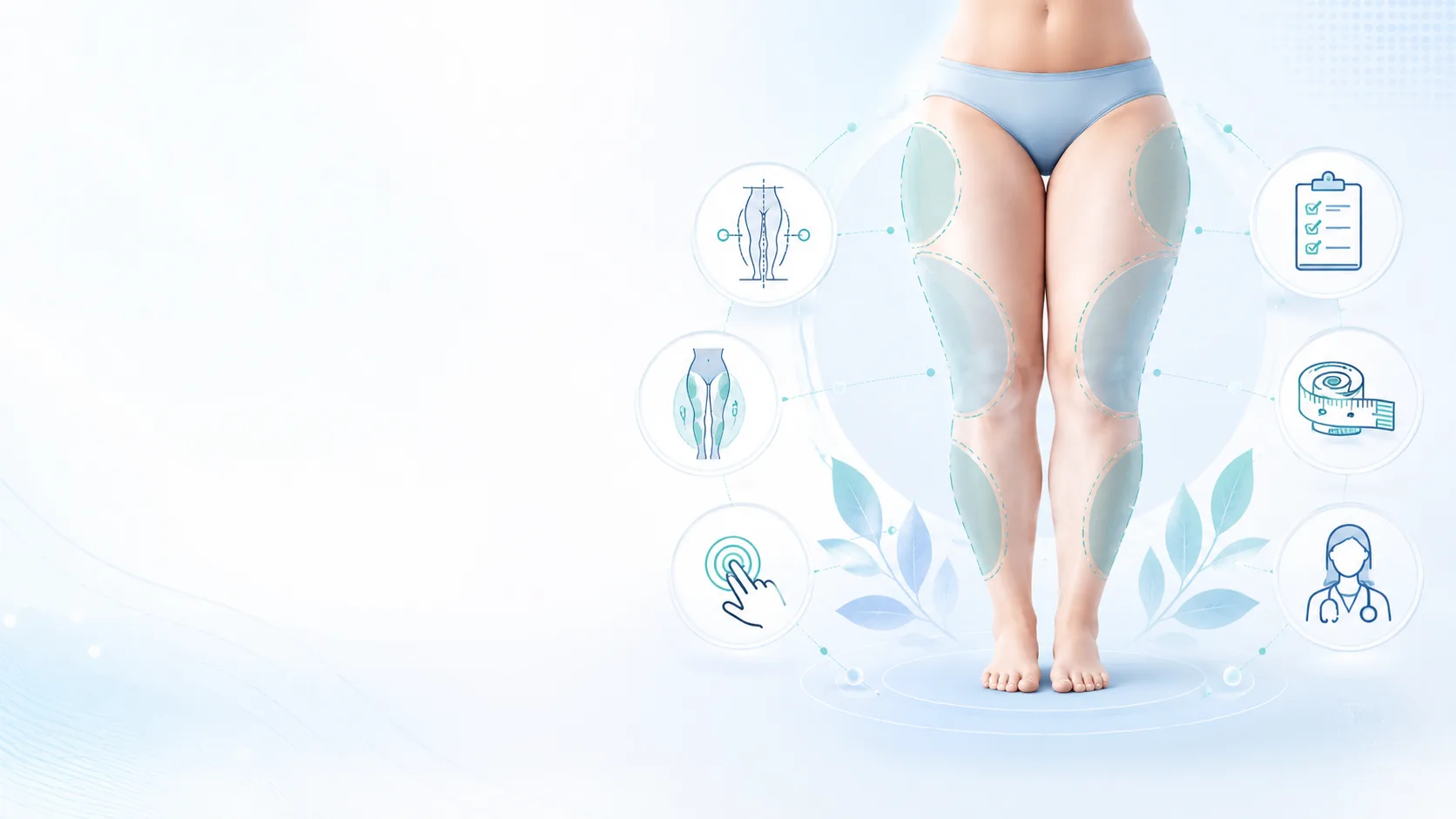
Lipedema types are a body map. They describe where lipedema tissue is distributed, while stage describes tissue texture and surface change. The classic anatomical system uses Type I, Type II, Type III, Type IV and Type V (Herbst, 2019; Herbst et al., 2021).
The goal is not to make patients memorize labels. It is to help them read what they see: where the leg enlargement begins and ends, why the feet may be spared, what an inner-knee fat pad suggests, whether arm involvement counts, and why the natural hollow around the ankle may disappear.
Type and stage are not the same

Stage describes tissue behavior: smoother skin, nodules, lobules or folds. Type describes location. A patient with Type III lipedema may be Stage 1, 2 or 3. This is why lipedema stages and type classification should be read together, not confused.
The classic body map
Type I affects the pelvis, buttocks and hips. Type II extends from buttocks to knees, often including tender fat around the inner knee. Type III extends from buttocks to ankles and may create a cuff while sparing the top of the foot. Type IV involves the arms and often accompanies Type II or III. Type V, rarer, mainly affects the lower legs (Herbst, 2019).
Type I: hips, pelvis and lower-abdominal transition
Type I may look like persistent fullness around the hips and saddlebag area. Some clinical discussions also pay attention to the lower abdomen, groin line and pelvis-to-hip transition. This should not be turned into a separate official type. It is better viewed as an examination note that must be interpreted with lipedema symptoms and the patient's history.
Type II: thighs and inner knees
Type II is often felt in the thighs and around the knees. Patients may describe trousers tight at the thighs but loose at the waist, rubbing of the inner thighs, or soft tender pads near the inner knee. Lipedema does not have to reach the ankle to be real; lipedema diagnosis methods remains broader than the type label.
Type III: full-leg pattern and ankle cuff
Type III is the full-leg pattern from buttocks to ankles. The feet are usually relatively spared. A cuff at the ankle, a sharp transition, or fat pads around the malleolar area may be seen (Herbst, 2019; Fife et al., 2010). In this setting, lipedema and lymphedema differences is essential because lymphedema, venous disease and obesity can overlap.
Type IV: arm involvement
Type IV describes arm involvement. Arm-only lipedema is uncommon; it more often accompanies Type II or III (Herbst, 2019). Upper-arm heaviness, tenderness, easy bruising, nodularity around the elbow and relative hand sparing can be relevant. arm involvement in lipedema should be considered when arm symptoms affect clothing, movement or compression planning.
Type V: lower-leg pattern
Type V is rare and mainly affects the lower legs. It can resemble a cankle pattern, but not every thick calf is lipedema. Muscle shape, venous insufficiency, lymphedema, thyroid problems and general weight distribution may look similar.
The disappearing ankle hollow
Fife et al. (2010) described filling of the retromalleolar sulcus around the Achilles tendon and fat pads near the lateral and medial malleolar areas. This does not diagnose lipedema by itself, but it can support the examination when paired with pain, symmetry and foot sparing. lipedema cuff sign explains why the ankle cuff can be clinically meaningful.
Is groin fat a new type?
Endotext describes lipedema fat from below the umbilicus to the bottom of the hips and notes deeper nodular adipofascia in the lateral abdomen in some women (Herbst, 2019). That makes the lower abdomen-groin-hip transition interesting, but it is not a validated standalone Type VI. Hernia, lymph nodes, visceral fat, PCOS, venous-lymphatic disease and weight change should be considered.
Why newer descriptions matter
Recent work from Herbst and colleagues encourages a more detailed look at pain, water, fat and muscle, including intermediate stage proposals such as 1.5 and 2.5 (Al-Ghadban et al., 2025). This does not replace the type system, but it shows why a modern body map should record ankle contour, knee pads, arm involvement, pain zones and function.
How type helps treatment planning
Type is not treatment by itself, but it guides compression, manual lymph drainage, exercise adaptation, photos, measurements, skin care and surgical planning. A Type III patient may need careful ankle and calf mapping; Type IV may require arm planning; Type II may need knee and thigh-friction strategies. lipedema vs obesity helps keep general weight burden separate from lipedema distribution.
In practical terms
Lipedema types describe distribution, not personal worth or severity. Type I maps hips and pelvis, Type II thighs and knees, Type III full legs to the ankle, Type IV arms, and Type V lower legs. The ankle hollow, malleolar fat pads, cuff sign and arm findings can make the map more precise. Groin or lower-abdominal fat is a useful observation, but not yet a separate official type. Awareness tools such as lipedema self-test may help patients organize what they notice, without replacing diagnosis.